Testimonials
Here are reflections and first-person insights, developed and crafted by four student researchers: Abigail Johnson, Chloe Regan, Eli Buechler, and another student. Each student researcher participated in co-creating a pop-up event as part of a third-year Philosophy class.
We thank the Faculty of Arts at Mount Royal University for supporting this work.
Making A trauma Kit: Reflections
-
I remember the class where we discussed “how to build a trauma kit,” and I immediately felt connected to Alyson Patsavas’s chapter because it drew attention to the small, everyday items people carry in a purse, backpack, gym bag, or pocket to help them move through the world.
Things like a wallet, keys, or a phone are often labeled as “essentials,” but their importance comes from what they allow us to do. A wallet holds money, identification, or even a rewards card from a local café. Keys provide access to a home that is locked for safety. A phone stores contacts, apps, and the internet, all of which help guide people through their daily routines.
A trauma kit reframes these objects by asking us to be more intentional and reflective about how material things support emotional regulation, comfort, and stability.
For me, this idea became very personal. I never leave the house without my headphones, which are honestly more essential to me than my wallet. Commuting without music is extremely difficult, and having that sensory support helps me feel grounded and regulated. At the same time, I recognize that this would not be true for everyone, and that difference is exactly what makes trauma kits so powerful. Their meaning lies in their subjectivity and individuality.
When we discussed what might be in other people’s trauma kits during class, it naturally opened conversations about differing needs and experiences. Those discussions encouraged us to think more intentionally about accessibility and inclusion, and about how spaces can be designed to support a wide range of comfort and coping strategies.
-
Reading Alyson Patasvas’s chapter, “How to Make a Trauma Kit,” for the first time reminded me of the measures we as curators at the Pop-Up Event took in order to promote comfort at our event, like the Relaxation Station that we set up.
It’d be unfair to directly compare our station to something like a trauma kit but one idea both our station and the trauma kit have in common is comfort during sensory overload.
Events like our pop-up can become quite noisy, and while some may thrive in high energy environments, I think a low energy location may benefit people who may grow easily overstimulated, myself included.
Alyson Patsavas, the author of “How to Make a Trauma Kit,” refers to the object in a trauma kit as “sensory soothing items”: this reminds me of the items we placed inside the relaxation station.
To promote a feeling of 'zen' in the space, we chose certain comfort foods like cookies, tea, coffee that many of us find reminiscent of good times, sweetness and calm. This idea of “sensory soothing items” makes me wonder what other types of objects curators in general can introduce in their events to create a safe, soothing space.
This also makes me want to pause and reflect on how students can use our own experiences to help curate sensory soothing experiences for all attendees, including students. How do our own needs and intuitions about needs lead directly to ideas about the possible needs of others?
-
The moment that really made me “buy in” to our pop-up project happened about three classes before our event, once groups had been formed and collaboration became central to our class time.
We held our classroom conversations in a circle: each week, we spent some time rearranging the tables so that we could all see each other, instead of staying in traditional rows. This small but meaningful shift made the space feel more like a council or community meeting than a lecture.
When the classroom no longer felt hierarchical, it became easier to step out of the role of “student” and into the role of collaborator.
As the semester progressed, discussions often moved between the larger circle and smaller group conversations within it. Over time, this built familiarity, trust, and comfort among classmates, which mirrored the values we were discussing through concepts like trauma kits.
Creating an event that moved beyond a typical class project required stepping outside of traditional classroom structures. Without that shift, the focus would likely have remained on grades, rubrics, and professor approval. Instead, the environment encouraged creativity, shared responsibility, and genuine engagement.
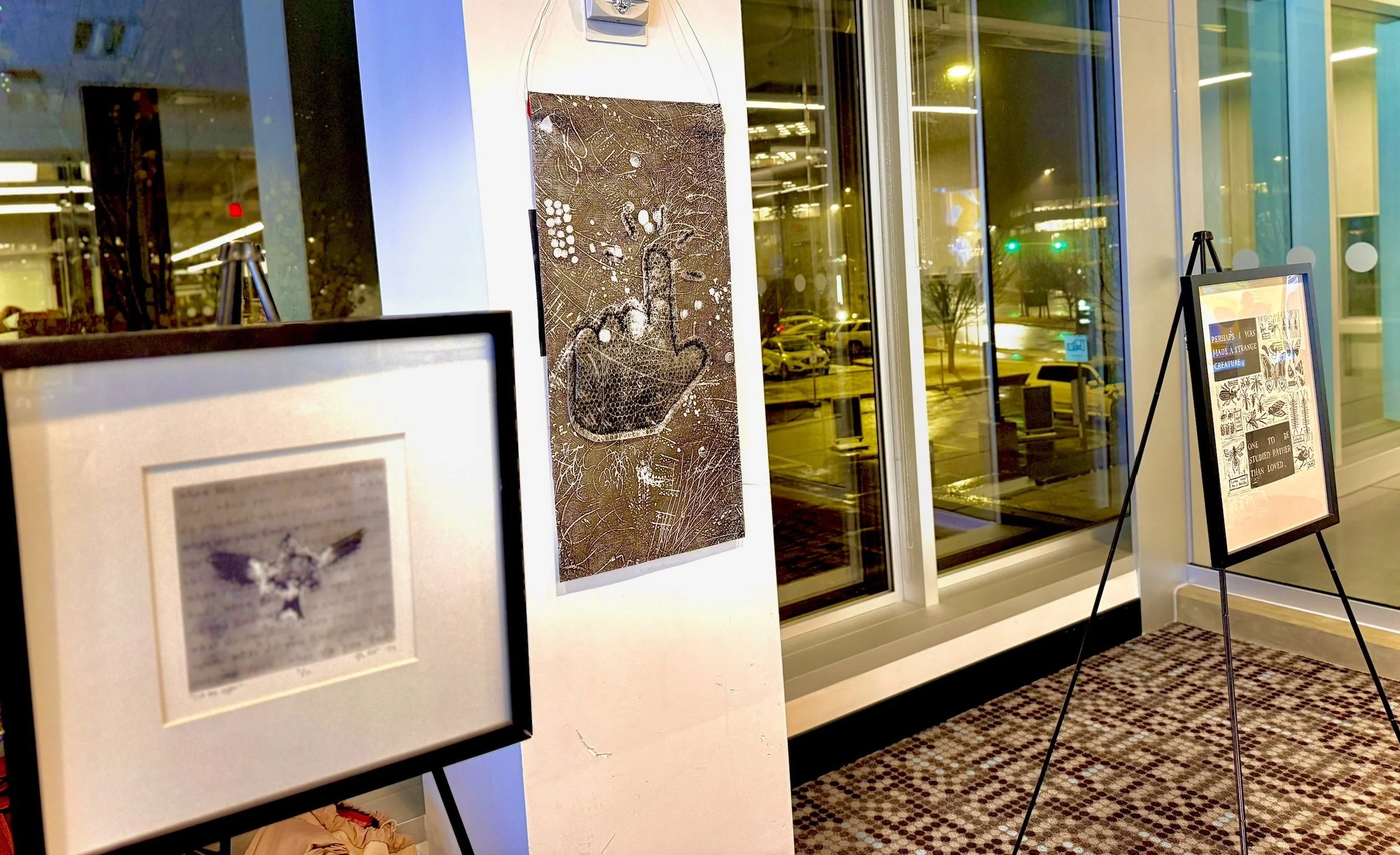

Prints by Míša Štorková (BFA, University of Calgary), one of the invited artists whose work was showcased at the Pop-Up at Mount Royal University in fall 2025.
Planning: Reflections
Student co-creators decided to host a quiet journaling and sketching space during the 2025 Pop-Up event.
-
Access Priming is, in part, an invitation to explore and experiment: let ideas run wild!!!
Events like a pop-up scream “creativity”. From an Accessibility Guide to activity and relaxation stations, for example, we crafted fitting, simple, yet memorable components for the event.
From my perspective, there was no list like “must not do” or “not allowed,” and so students brainstormed ideas, without that mental weight of “what if this isn’t permitted?” This enabled students to come up with unusual and whimsical ideas to propose or execute without shame in fear of being shot down. A personal example is the “touch” and “don’t touch” symbols I created.
As part of this display, I knew from the get go that I needed to create symbols that would indicate to folks whether the artworks on display could or could not be touched. I then allowed my mind to run free and come up with what I’m sure many consider an unusual design for an event held at an academic institution.
The result of that were cute bunnies prompting you to touch or not touch the artworks. I am sure other classmates came up with interesting ideas due to the lack of rigid constraints as I did.
Another crucial aspect of no constraints benefitted students by letting their voices be heard. Constraints often drive people into corners, leading to self doubt on whether their ideas are worthy. This generates resistance, meaning less ideas are expressed that may in actuality greatly benefit the event.
-
Students are often underestimated. There is a common assumption that we need everything tightly controlled or simplified; otherwise nothing productive will happen. Because of this, students are frequently treated as if they are only there to follow instructions rather than think for themselves.
This pattern starts early in school and never fully disappears: a project is created by a professor, and the students are expected to recreate it as closely as possible. The focus becomes figuring out what the instructor wants instead of actually engaging with the ideas. It is like learning a language but only being allowed to speak pre-determined sentences and never freely conversing. Why care to learn and be motivated to speak the language when you can only repeat the same sentences so many times?
Over time, this approach turns learning into performance instead of participation.
When education works this way, it’s easy for students to start seeing school as something to get through, rather than something to take part in. You aim to meet the rubric, avoid mistakes, and move on, instead of taking risks or exploring ideas. This is exactly what student-led work pushes against. It creates space for students to make decisions, take responsibility, and actually use their own judgment. However, for this to work, students cannot simply be thrown into leadership roles without support.
This is where priming becomes essential.
Students are very good at reading the energy of a classroom. The first day of class, no matter how many years of education a student has been through, is usually stressful. Even in a classroom with a friend or a familiar face, it is still mostly full of strangers. Everyone is quietly trying to figure out what kind of space this will be and how safe it feels to speak. This is why so many students dread icebreakers: they ask people to be vulnerable before any real trust has been built. Still, discussion and group work are central to collaboration, so these early nerves cannot simply be ignored.
Small choices in how a classroom is set up can make a bigger difference than people realize. For example, when chairs are arranged in a circle instead of in rows, the whole feeling of the room changes. Rows make it clear that the focus is on the instructor and that students are there mainly to listen. A circle, on the other hand, makes the space feel more shared. Everyone can see each other, and it becomes easier to think of the class as a conversation rather than a lecture.
This kind of setup quietly signals that student voices matter and that participation is part of what the class is for.
Small group discussions build on this in an even more personal way.
Speaking in front of a whole class can be intimidating, especially at the beginning of a term. In smaller groups, it is easier to talk, to listen, and to start getting comfortable with the people around you. You begin to recognize faces, hear different perspectives, and realize that others are just as unsure or nervous as you are. Over time, this helps create a sense of connection and even unity within the class. The room stops feeling like a group of strangers and starts to feel like a group of people working together.
All of this directly supports student-led events and projects. If students are not primed first, “student-led” can end up being just a label, while everything still feels controlled from above. Students may technically be in charge, but they might not feel confident enough to actually take ownership.
When the environment supports connection and trust, however, students are more willing to step forward. They can start to use skills that do not fit into standardized testing but still matter a great deal, such as organizing, leading, supporting others, and keeping a group focused.
In the end, priming is not about making things easier or lowering expectations. It is about recognizing that students are often underestimated and creating the conditions for them to actually show what they can do.
When classrooms are set up in ways that encourage connection, and when students are given chances to talk in smaller groups and lead their own projects, learning starts to feel more real and more shared. Student-led work only truly succeeds when students are first prepared to step into those roles, and that preparation starts with taking students seriously as capable and thoughtful people.
-
This reflection invites instructors to turn “access priming” into a practice of self-exploration.
Despite some initial uncertainty about this activity, my classmates and I proceeded enthusiastically, and our pop-up event went off without a hitch. How? This reflection offers insights drawn from our own experiences.Through reflections on the planning we’d done together, we came to realize that there was a distinct moment for each of us, or perhaps a series of moments, in which the idea of the pop-up began to feel like it could become reality.
A common theme in these reflections was a sincere passion and belief in the project on the part of our instructor. Perhaps it feels like a cliche to mention simple enthusiasm, but in our case, it would be apt to describe these emotions as an embodied experience that spread from the centre (the instructor) out to a few students and then to the fringes of the classroom, cumulatively affecting everyone and motivating them to become participants, organizers, and curators.
By explicitly acknowledging your own personal stakes and interests in the project, as the instructor, students are invited to become similarly open to the “condition of being affected,” which allows realization and mobilization of a student’s own stakes and engagement (Butler, 2016, p.18; Changfoot, 2022).
Put differently, this promotes an expression of student agency, which a student-led pop-up is all about. Telling students how to approach the project may be involved, and this can be modelled for the students with your approach.
And so, perhaps the most important and generative place to start this (or any) project is with a reflection on what passions, interests, hopes facilitated your arrival to a student-lead pop-up as interesting to you: was it an alternative mode of assessment, an idea you want your students to linger on, an experience you want them to have?
You can also reach back further, into why you’re here teaching your class in the first place. Your memories, expertise, and passion for the topic of your class and event can become resources which may be shared, transmitted amongst the class.
Alyson Patsavas, in the chapter How to Make Your Own Trauma Kit, which inspired this project, describes the utility of these memory-resources as both calming and archival; enlivening the past by retrieving their joy in the present.
These can similarly be used to express your vulnerability and interest, and encourage students to do the same. As a person in whom students invest their trust, you’ll be observed by students, as they take hints about how to behave in this new situation. This presents an opportunity for you to show up in a way that is positive, welcoming, and, in a way, an introduction to the work that will be done within the project itself, as students access their own interests and vulnerability to curate the event, from the first moments of class.
Establishing trust
You understand that students have a clear role in this project: as designers, making choices and guiding the project according to their different skills and interests. Outside of the need for a grade to be produced from this, which we discuss below, where does that leave you in this equation?
You’ve likely detected that the goals and methods of a student-led pop-up are somewhat at odds with how power is typically constructed in a classroom: the teacher or professor stands at the front and leads, while students typically passively listen. They may occasionally answer questions or comment, but they do not often alter the teaching material, be that lectures or assignments. They are recipients of these methods and the knowledge they are said to contain, not designers themselves.
This pop-up activity aims to involve students dynamically in the learning process by opening up possibilities for both academic labour (students choose their tasks or contributions) and its outcomes (what the event itself looks like is determined by the class).
We recommend that the professor adopt a perspective of scaffolding this process, guiding as opposed to deciding the processes by which students contribute and outcomes are formed. This has the additional effect of promoting a relationship of trust between yourself and your students, which I would argue is required for a task like this.
By considering new ways to go about processes of learning and assessment, not only is deeper learning facilitated by the disruption of automatic thinking, but critical thinking is expressly required to adapt to a novel learning engagement. This process is scaffolded and entrusted to the students in the case of the event, rather than merely encouraged.
Altering possibilities in learning and assessment
This may sound great, but perhaps a question has been coming to your mind: when it's all said and done: how do you grade an experience like this? Naturally, this is an important consideration as you start taking this idea seriously.
Of course, students will understand that all this is being done for course credit, but maintaining a focus on process over grading outcomes is essential to maintain intrinsic motivation as the generative force behind the event. Intrinsic motivation is the drive to do something because it is personally, internally rewarding. Compare this with extrinsic motivation, which is the drive to do something for some external reward. (Both kinds of motivation are derived from Ryan and Deci’s (2000) self-determination theory).
Grades are an excellent extrinsic motivator to get students ‘in the door,’ but intrinsic motivation sustains personal engagement and greater depth of learning (Larson & Rusk, 2011). The way this was accomplished during our pop-up activity was achieved through what could be described as a turn towards process and becoming as the demonstration of our engagement and enquiry rather than merely considering the final product.
To open up this discussion, consider how students are graded in more common types of assignments, using the example of an essay. The processes of writing, researching, exploring, aspects of learning which an essay demands and is said to develop, are inevitably present in the final project as they are what creates it, but they are subsumed within the final product, rendered invisible through the act of making them into a stable, polished thing.
A pop-up is very different in this regard. Though some work will, naturally, be taken home and transformed into deliverables by students, the process or the becoming of the event is philosophically of key importance, as students actively turn the event into something totally unique, contingent on their gathering in the classroom and their interests as students.
There is indeed a philosophical movement referred to as process philosophy, which is a deep vein running through the lineage of continental philosophy, including disability studies, which we focused on in detail and which underpinned the choice of pop-up as an activity (Seibt, 2022).
To return to the question of how to assess an experience like co-creating a pop-up, it’s helpful to make use of process-based approaches to assessment, like self-assessment.
-
I entered this activity and the curation process with an open mind, though I was aware of the workload involved. As a student, the prospect of creating, hosting, and producing an art and philosophy pop-up was both exciting and slightly unsettling, particularly because of the collaborative nature of the project.
My past experiences with group work in academic settings had shaped certain expectations—often involving last-minute coordination, with only one or two committed members carrying the bulk of the work. If that dynamic had emerged here, it could have placed a heavy burden on only a few students.
However, as discussed throughout this guide, there were specific moments that encouraged us, as students, to truly invest in the idea of curation.
The pre-event planning and preparation were important in shaping this shift. Through those early stages, the project began to feel less like a typical assignment and more like a shared responsibility and opportunity. That process helped build a sense of trust within the group and made it easier for me to fully commit to the course and the event, embracing whatever level of work and collaboration would emerge.
First-Person Experiences: Reflections
-
Our pop-up event was meaningful and successful, from my perspective, for one key reason:
we each chose our roles based on our strengths and interests.
A trend I’ve noticed in my classes is that students tend to be assigned tasks without much choice in what they wish to do. Students are handed certain topics, responsibilities, and assignments with little wiggle room for personal preference or expression.
I find that this limits one’s potential to perform effectively. A major reason in why humans both perform well and feel motivated to partake in activities lies with types of motivation.
A form of motivation that comes from within (like pure enjoyment and personal satisfaction) will help someone to not only have fun but truly engage with the subject matter. This is intrinsic motivation.
Giving students a choice to potentially work on tasks that they carry a personal interest in increases this intrinsic motivation factor, improving their performance as well as their attachment to the assignment.
And this gets to the heart of why we might want to participate, at all.
I definitely felt a boost in my motivation to participate when I found out that design/artistic elements were involved, seeing that art is my passion.
At the same time, I did not feel pressured to make a decision right away on what role I wanted to play. That allowed me to reason with myself and really think about what I’d like to work on later down the line.
I believe that slowly introducing components of the activity, rather than presenting everything all at once, is less overwhelming because we can digest information in smaller chunks and raise concerns/questions without any additional noise. For example, the fact we spoke about this pop-up project during the second week of the semester, slowly incorporating more elements throughout the term, gave me more prep time.
The general enthusiasm and excitement I felt from our classmates equally motivated me (these feelings are contagious), though I believe atmospheres are in part promoted by the professor.
And so this pop-up assignment does invite important attention to how an instructor is behaving and communicating, most importantly in terms of fostering enthusiasm among the class.
Along these lines, I’d like to encourage professors to relate to their own role as a guide, rather than as a high authority figure, and to relate to group discussions as experiences that forge and foster comfort.
-
These kinds of activities allow students to show skills that are rarely valued in standardized testing. Abilities like communication, leadership, empathy, creativity, and the ability to read a room do not show up on exams, but they matter a lot in real learning.
Some students who struggle with tests do extremely well in settings where they can organize, facilitate, or guide discussions. Others may not excel in written assessments but are very good at bringing people together or helping conversations move forward.
Student-led events make room for these strengths and show that learning is not only about producing the right answer under pressure, but also about working with others and contributing in meaningful ways.
-
During the pop-up event itself, there was a noticeable surge of adrenaline.
Speaking in front of people, ensuring everything ran as smoothly as possible, and responding to the inevitable last-minute adjustments created an energizing atmosphere.
Our professor had advised us to take care of ourselves that evening and even suggested taking the following day off if possible. At the time, I did not take this advice too seriously, but the next day I found myself unexpectedly drained. The exhaustion caught me off guard and made me realize how much emotional and physical energy had gone into the event.
Assessment: Reflections
-
One aspect of the experience that surprised me was the post-event transition.
Reflecting on the experience, both from the student and professor perspectives, felt important, particularly if we were to step outside the usual academic norms of evaluation.
Returning to class and falling back into the typical routine of lectures and assessments felt somewhat strange after completing something that had felt so monumental. For a moment, it almost felt as though the course itself had concluded, even though we still had several classes left that included thoughtful philosophical discussions.
An important moment that helped ground the experience was the reflection time built into our first class after the event. This provided space to revisit the experience together and acknowledge what had taken place. It felt like an opportunity to share memories, discuss highlights, and process the event collectively, while still engaging in more structured reflection. Our class was also given the following class day off, which I appreciated. A great deal of time and effort had gone into the event, and that pause felt like an acknowledgment that it was something worth celebrating.
-
There are moments when being a student can feel isolating.
Much of academic life involves focusing on screens, assignments, and grades, rather than the people around us. Activities such as engaging with Mimi Khúc’s Student tarot card made me reflect on this dynamic more clearly. I realized how often I measure myself against my peers, which can make forming genuine connections within a class more difficult.
After the pop-up event, however, there was a noticeable shift in the atmosphere among classmates. There was a familiarity that had not been present before, an unspoken sense that we had all shared something meaningful together. We had seen one another in a different light, not just as fellow students, but as collaborators and contributors to a collective experience.
Grading became secondary to the experience itself.
Beyond my personal reflections on this experience, I have developed several actionable considerations that could help foster similar or even improved experiential learning opportunities for both students and professors.
These suggestions are intended to encourage a greater emphasis on experiential learning within academic environments while still acknowledging the practical need to evaluate and assign grades to such experiences.
One aspect of this project that helped reduce the pressure typically associated with grading was the absence of a designated “grading day” during the event itself. Without the immediate presence of formal evaluation, the environment felt more collaborative and less performative, allowing students and the professor to work together toward a shared goal. Introducing overt evaluation during the event may risk influencing behaviour through what is commonly referred to as the Hawthorne Effect, the tendency for individuals to alter their behaviour when they know they are being observed. In a context such as this, visible grading could unintentionally shift attention away from authentic participation and toward performative engagement.
That said, assessment remains a necessary component of academic work. Here’s my suggestion for how to relate to assessment, in the context of a pop-up assignment.
Professors should consider the collective effort demonstrated throughout the semester rather than focusing solely on performance during the event itself. Participation, preparation, and engagement over time provide a more accurate reflection of each student’s contribution to the project.
Both students and instructors are often aware of the varying levels of effort within a group setting, making it important that grading practices recognize meaningful participation rather than rewarding mere presence.
In other words, there must be a fair distinction between students who actively contribute and those who participate minimally. From the instructor’s perspective, this differentiation may already be somewhat apparent through ongoing classroom interactions and participation throughout the term. Continuous engagement provides valuable insight into student commitment and effort, which can then inform a more balanced and equitable evaluation.
Perhaps the most important component of assessing experiential learning, however, is providing students with space to reflect on their experiences and the work they contributed. Reflection allows students to critically evaluate both the process and the outcome of the project, helping them articulate what they learned and how they participated.
At the same time, collaborative projects must be structured in ways that distribute responsibility among participants. While the idea that “many hands make light work” often holds true, it is important to ensure that the workload does not fall disproportionately on a small number of students. If participation is uneven, some students may have little meaningful experience to reflect upon, undermining both the collaborative process and the learning objectives of the project
Another suggestion is to draw on our own experiences, which involved self-assessment.
The grading structure for our course relied largely on self-assessment and reflective evaluation. This approach aligns well with experiential learning models, as the depth and quality of a student’s reflection often reflect the level of engagement they brought to the project. In practice, students who contributed more meaningfully to the process typically have richer experiences to analyze and discuss, while limited participation naturally results in more constrained reflections.
Depending on the nature of the experiential activity or event, instructors may choose to balance several forms of evaluation, including reflective writing, self-assessment, and more traditional academic measures. The weighting of these components should be adaptable to the goals of the course and the structure of the project. However, the level of commitment required from both students and the instructor must be recognized within the grading framework.
Experiential projects demand significant time, coordination, and collaboration, and assessment practices should acknowledge the effort involved in making such initiatives successful.
One practical strategy is to provide guiding questions that encourage meaningful reflection and self-awareness. These prompts can help students clearly articulate their involvement, responsibilities, and contributions to the project. At the same time, they should leave space for the instructor to apply their own evaluation based on observed participation and engagement throughout the course.
Evaluation in this context might focus on several key areas, including evidence of student growth, the ability to engage with and interpret key course themes, and the specific tasks or responsibilities the student contributed to the event. By combining reflective self-assessment with instructor evaluation, this approach can create a more balanced and equitable system for assessing experiential learning.
This guide for reflection activities might be helpful for thinking of activities that will work well. Our class made use of ‘The Hundreds’ exercise (see Step 5 Reflecting) as well as small group conversations anchored in reflective prompts.
I also suggest an exercise like “postcard to future self”: participants write a letter or postcard to themselves about their goals, feelings, or lessons learned. The facilitator collects them and sends them out later.