Step 5: Reflecting
Resources for Reflecting
As student researcher Chloe Regan notes, in the Testimonials, reflection should be seen as an essential component of the overall experience. The ephemeral nature of a pop-up event makes it both satisfying and challenging, when it comes to summoning up reflections.
Here is an article, as well as an interactive activity, that we recommend as resources for anchoring this kind of reflection.
A suggested reading to anchor reflections
We recommend the following article:
Suze Berkhout & Kelly Fritsch with artists, “Frictional Spaces, Sense-Knowledge-Affect Loops, and Arts-Science Collaborations in Transplantation: A Roundtable Discussion,” forthcoming in philoSOPHIA: Feminist Continental Philosophy special issue on the Atmospheric Turn.
In this article, Suze and Kelly explain, “Typically linked to an overarching ethos of creative placemaking, pop-ups draw out temporal notions of transience and the ephemeral as well as play with the unexpected and the incongruous in terms of siting and space.
“In addition, concepts of participation, art in everyday life, and alternative futurities are a part of the pop-up ethos, often with an aim of making and thinking outside of the confines of traditional institutional values and structures.”
Reflections might tune into the specifics of the pop-up ethos, as co-creators noticed and experienced it; it’s an excellent idea to draw out the “unexpected” and the “incongruous” of siting and space, as they showed themselves at the pop-up event.
A suggested activity to facilitate reflective conversation
We suggest an activity called “The Hundreds” to prompt reflections that may emerge through loose, free-thinking handwriting.
“The Hundreds,” an activity similar to the surrealists’ Exquisite Corpse, requires each participant to have a paper with three sets of one hundred boxes (a grid of ten by ten, laid out three times on a page).
The exercise begins when every person handwrites a response to a prompt (it could be something like, what memory stands out most clearly from the pop-up event?), putting one word in each box: each person will write 100 words exactly. The exercise continues when each person hands their paper to the person to their right, as they receive a paper from the person on their left.
After reading the 100 words in the first grid, each person writes a response by way of handwriting 100 words, putting one word in each box. The exercise continues, as each person hands their paper to the person on their right and responds to the paper they’ve received, putting one word in the 100 boxes in the third grid.
The exercise concludes when everyone receives their initial paper back, enabling each participant to read the three hundred handwritten words on the page. It’s an excellent idea, finally, to invite reflections on the experience, perhaps including some participants deciding to read the words aloud.
The spirit and inspiration of surrealist games informs the Feminist Making, Doing, and Sensing collection, as described in the book’s introduction.
Deep thanks to Maya Hey and Anna Sigrithur, who presented “The Hundreds” at the 2024 philoSOPHIA conference on feminist making held at the Mount Royal University Library.
Here is Maya and Anna’s description of The Hundreds: A Co-Writing Practice:
“The Hundreds has been an experimental, feminist and collaborative practice from the get. By limiting texts to the length of one-hundred words, the formal constraints on creativity and fluidity makes it great for imploding, slicing through life, and incising insightful commentary. These are short, profound ruminations. Manageable in length, but potent in meaning. Why?
“Because the economy of words makes word choice matter all the more: every word must do some heavy lifting. Could it cut out excessively florid language? Academic-ese? This participatory exercise offers ample opportunities to try this practice on for size. It’s a meditation on one-hundred words. We will experience this along the lines of Exquisite Corpse. Like the drawing game, each member will start with one set of hundreds, and the next person will continue where the last person left off; the theme will be decided by the first writer.”
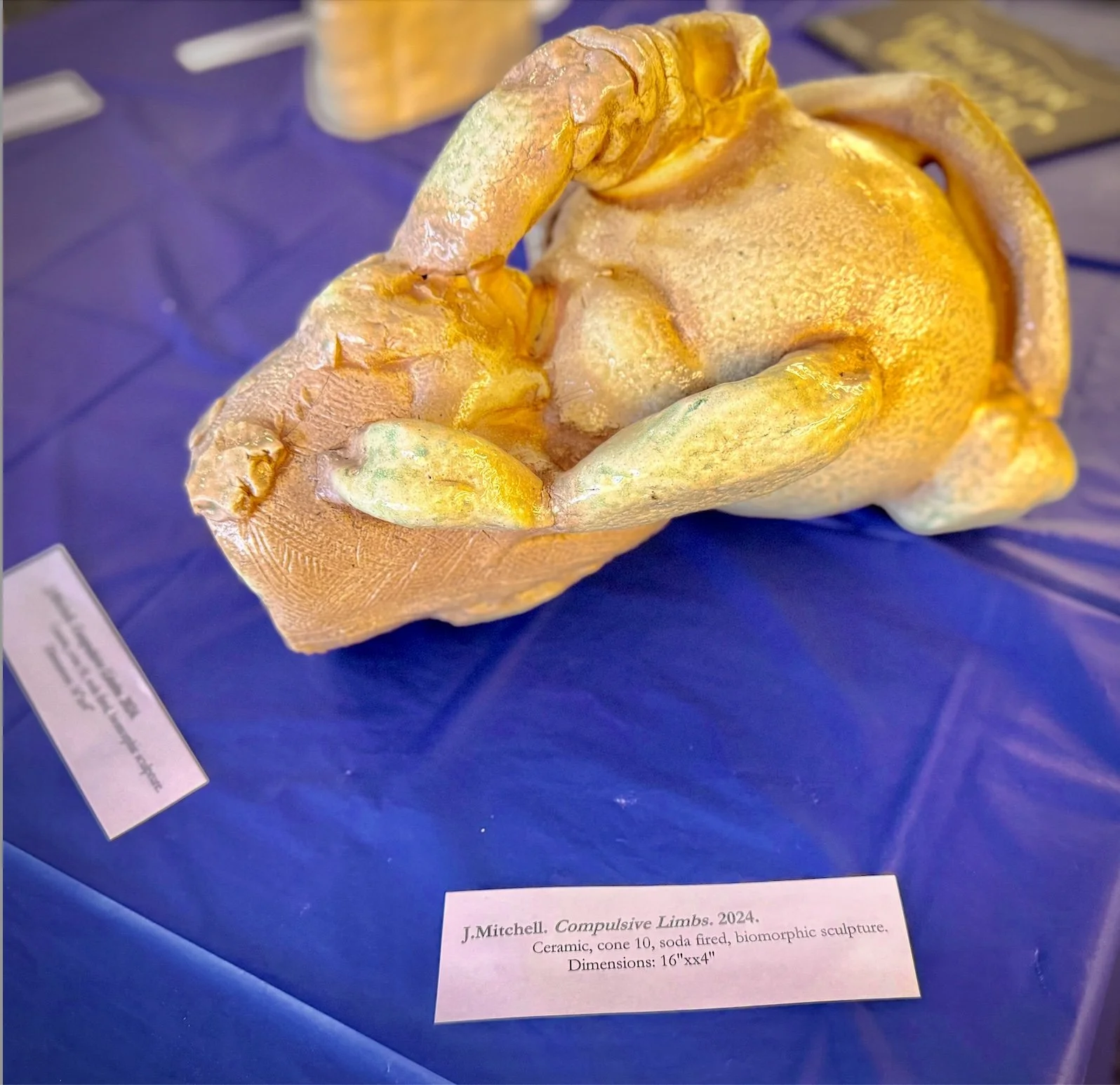
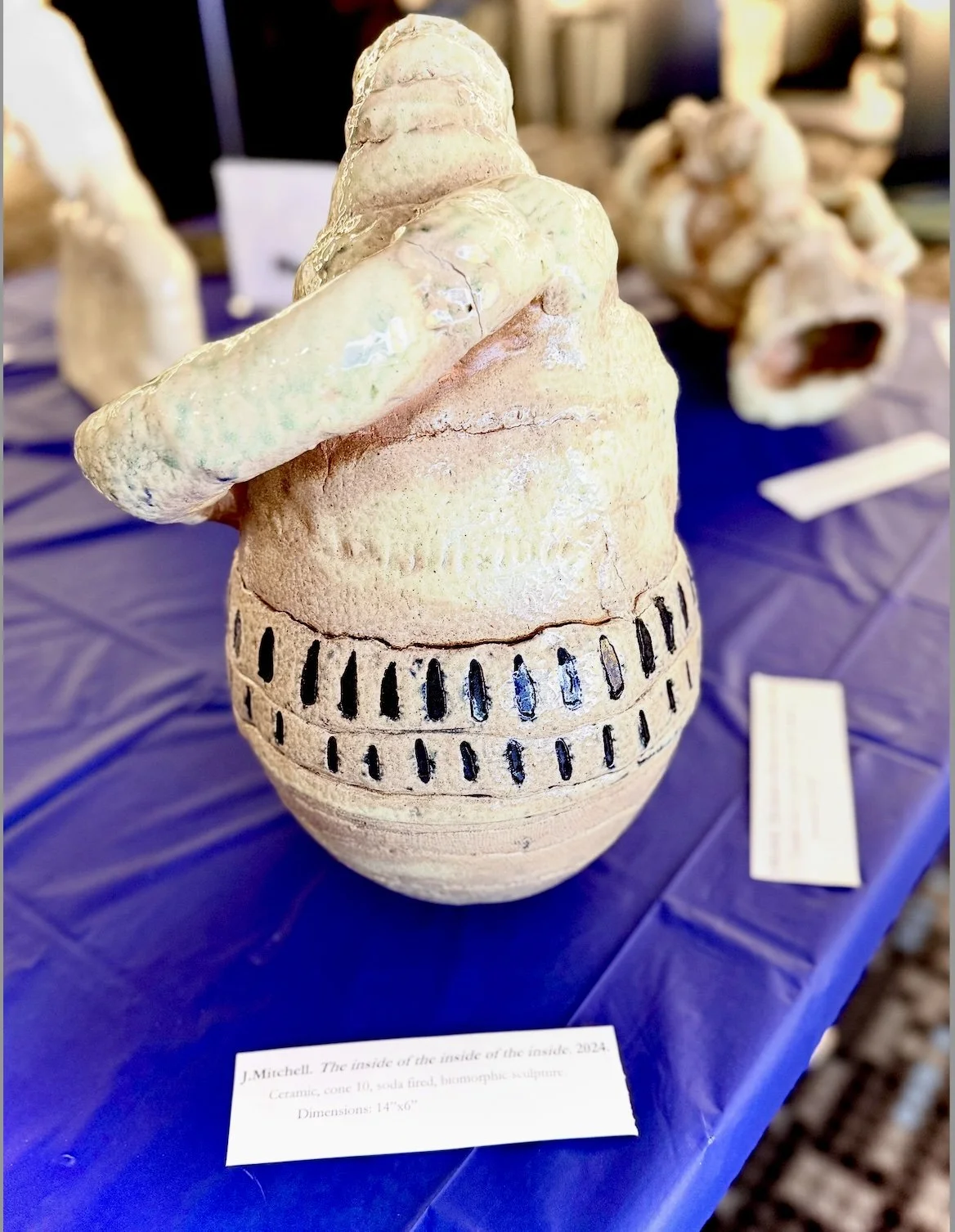
Sculptures by J. Mitchell, MFA, one of the artists showcased at the 2025 Pop-Up event at Mount Royal University.